
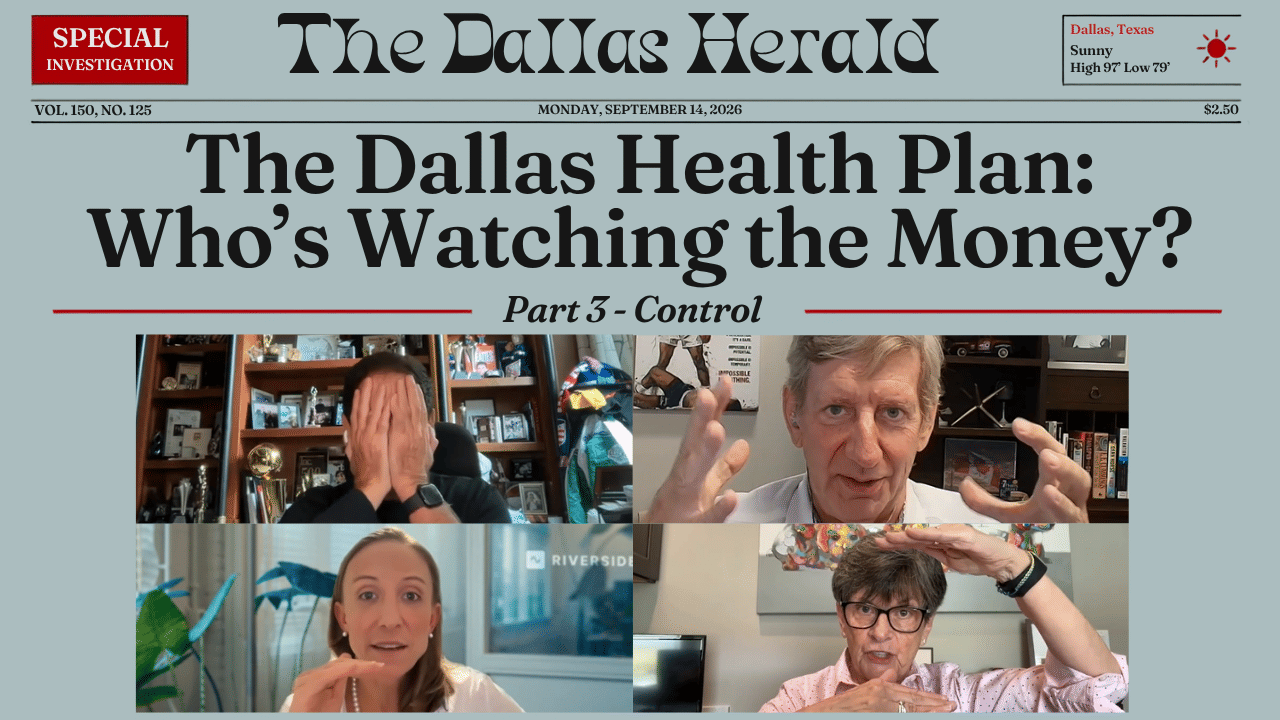
After examining claims visibility and the contract itself, Part 3 asks the most important question: Who should actually be responsible for managing the money?
In the final installment of our three-part series on the City of Dallas health plan, Ralph Weber is joined by Mark Cuban, Chris Deacon, and Marilyn Bartlett to move from diagnosis to possible solutions.
The discussion focuses on what active health-plan management could look like for Dallas and for other employers and public entities funding their own healthcare plans.
Mark Cuban argues that organizations need dedicated expertise capable of reviewing healthcare spending as it happens – rather than relying primarily on audits after the fact. Chris Deacon raises a broader question about how much administration and control public plans should outsource. Marilyn Bartlett brings the conversation back to a fundamental accounting principle: if an employer funds a claim, it should be able to reconcile that funding to what was actually paid.
In this episode:
Why healthcare spending should be treated as a major financial responsibility, not simply an HR function
Why Mark believes employers need dedicated health-plan expertise
Why managing large claims in real time may be more valuable than discovering problems later through an audit
The importance of preserving data, RFP, and contractual rights before claims are paid
Whether public employers should consider retaining more administrative capability and control
How AI and better technology may help – and why expertise still matters
Why “disruption” should not automatically be treated as a negative in healthcare
The basic accounting question every self-funded employer should be able to answer: Can you reconcile what you funded to what was actually paid?
Why long-term healthcare contracts need to account for changing requirements
What Mark says employers can gain by taking a more active role in managing healthcare
This is Part 3 of 3 in The Dallas Health Plan: Who’s Watching the Money?
Part 1 – Visibility: What can Dallas actually see?
Part 2 – Contracts & Incentives: What does the fine print actually permit?
Part 3 – Control: What should Dallas and other employers do about it?
Guests:
Mark Cuban – Entrepreneur and Co-Founder of Mark Cuban Cost Plus Drug Company
Chris Deacon – Healthcare attorney and former Director of the New Jersey Division of Pensions & Benefits
Marilyn Bartlett, CPA – Nationally recognized healthcare cost-containment leader and former administrator of the Montana Employee Health Plan
Host:
Ralph Weber | The Benefit Whisperer | Route Three
If this series has changed the way you think about healthcare purchasing, share it with a CEO, CFO, HR leader, benefits professional, public official, or anyone responsible for managing a self-funded health plan. Subscribe to my YouTube Channel as we address more in the healthcare world!
Music licensed through Soundstripe.
Code: YTA6TLJZGWC58KTH
[00:00:00] Healthcare isn't broken. It's working exactly as designed for the people who never send you the bill. Every year, employers fund more and more care and see less and less of where their money goes. Prior offs, denials, PBMs, markups stacked on markup. This is the show that says the quiet part out loud. I'm Ralph Weber, The Benefit Whisperer. And if you write the check, you deserve to see inside the black box.
[00:00:28] So what we know now is every company, city, state, whatever, needs a Chris and a Marilyn on staff. Yeah. No, absolutely. For real. For real. You guys can make a lot of money training people to do what you do and then placing them at companies. I'll keep you busy. I'll get all these big companies I talk to. Talk to Marilyn and Chris. They'll get little baby Marilyn's, little baby Chris's, right, to come out there and help you.
[00:00:52] And I'm serious because you're going to, you know, whatever it is you pay them, they're going to save a multiple of that amount every single year. And 100% of that money goes right to the bottom line for that employer or for that city or for that state. I mean, it needs to change.
[00:01:10] Yeah, exactly. When I was looking at the state of Tennessee a few years back, they had $2.7 billion of bill charges, $1.6 billion of paid claims. Their in-network providers were actually paid 6% more. Sorry, their out-of-network providers were getting 6% less than their in-network.
[00:01:31] So in other words, the network was paying more. So I said, why do you even have a network? That's $96 million a year wasted. Like, why are you throwing it away? The whole idea of a network. And then variance within procedures, CT scan of the abdomen with and without contrast, the median charges were $635. The high, get this, $19,800 for a CT scan. That's crazy.
[00:01:56] That's not to buy the machine. That's to have a CT scan. Colonoscopy, $1,212 was the median. $17,304 was the high. But people aren't checking this. And that's the one claim I care about. I don't care about other ones. Yeah. I don't care about other ones. You know, one of the things I've been trying to do, and it fell flat, so I've given it up. But I wondered why insurance commissioners were not reviewing some of these provider network contracts.
[00:02:23] Because they just take, I did a little stint at the insurance commissioner's office here, and I see where the insurance commissioner's office receives the actuarial projections and rate-setting data from the Blue Cross Blue Shield or whomever. Right.
[00:02:39] And they just review that. But those provider network agreements, if they are, if the insurance commissioner is there to really protect the citizens and to really look at that rate setting, don't you need the fundamental underlying threshold pricing? Yes. The gold card? You need to know all that. Why don't they do that? Yeah. Because they don't want to. Good point.
[00:03:31] A CEO and HR head, chief people officer? How the hell are they going to know? That's why it's incumbent. And I'm serious when I say, if you guys, you know, taught people how to be internal TPAs effectively. you can make a real business out of that because, you know, you guys know Ryan Klein. We're talking all the time now about how to do TPA in the box where we teach a company or we provide a company everything they need except for the care navigation.
[00:03:58] Because you don't want a company having internal people dealing with the care navigation. Right. You want some space between that. And so other than the care navigation and all that stuff, there should be a Marilyn or Chris on site or on staff full time. Looking at all those, just like Marilyn, you go through, Chris, you go through them and you analyze these by putting them on full time. You get to get it before it's a problem where you have that you have to audit.
[00:04:23] You know, that's when you everything falls apart. By the time you have to audit, you've already gotten ripped off. Yeah, no, exactly. And yeah, maybe you can recover 70 percent of it. But even so, the time it takes and the effort it takes. And, you know, there's only so many Chris and Marilyn and other companies that do the audits. It's right. You've got, you know, and you've got it. There's so many steps that have to happen.
[00:04:46] And then more often than not, it's getting delayed. You're only getting your 300 or then they say they gave you everything. They didn't give you the feels. They didn't give you everything. They know they ripped you off. Yeah. They're doing everything possible to prevent you from confirming that they ripped you off. Right. You've got to get it up front. And the first place is the RFP. If you can't get at the RFP, you get it at the contract. And even once the contracts hit, if you go with somebody you can't trust, you've got to have somebody on site.
[00:05:16] And even then, you know, to Marilyn's point about negotiating earlier, stuff's going to happen. The shit's going to hit the fan at some point. Right. And you don't know what those future claims are going to be. And if it's the hemophilia drug, that's 2.5 million or whatever. You want to be able to negotiate that 340B price and make sure that somebody is not double dipping, et cetera, et cetera.
[00:05:39] And if it's, you know, a broken leg outside, you don't want the multi-plan or whatever they're calling themselves price because they're out of network. You can negotiate a better price yourself. Yes, you can. Yeah. And so if you don't know these things, you're doomed financially to have all these issues.
[00:05:57] And so I just think the number one thing that can happen in this industry is for self-employed and self-insured employers to have somebody on staff to be Marilyn and Chris and look at the claims as they come through. Because that will save you more money than anything. And guys, if you guys decide to train people and want to place them, you just let me know. You let me know what your fee is. You let me know how much they want to get paid.
[00:06:22] I will pay it for real because that company has 5,000 members, 50,000 members, 500,000 members. They're going to pay for themselves like that. Oh, yeah. Oh, yeah. I agree. I agree. We would be a good investment. Yes. And we work so well together, don't we, Chris? Yeah. And you know what? I can't hire you guys full time to go somewhere, right? What bothered me is when I went to the state, I naively thought I had a double whammy.
[00:06:50] I was a fiduciary over the plan and I was a steward over taxpayer money. You have to be on your game. You have to do everything you can to manage that. And yeah, I had a lot of darts thrown at me. A lot of horrible things happened. But, you know, I guess I'm just single-minded. That was my role. So public employers' health plans are even getting hurt harder. And I think we're at the point that it's crucial. They're having to give up benefits.
[00:07:18] A couple in the news lately have gone to fully insured. The public employers need help. Yeah. I mean, I like the bigger thinking, you know, and I think, Mark, you were alluding to this, but there's only so much tinkering around the edges, even with the most well-informed HR team or, you know, healthcare CFO if you're still working with a contract or a BUCA that's not going to let you do what you need to do. Mm-hmm. 100%. I mean, if you just think about what the city, let's say, city of Dallas, New Jersey, and Montana,
[00:07:48] those three public entities alone, how much they're paying in ASO fees a year, they could buy a TPA, staff it, and run it as a nonprofit, you know, cooperative or whatever, and make out like bandits. Yeah. And yet we continue to fork over not just money, but control. Yes. You know, I think there are some big ideas out there that really, it's time. It's time to explore them. Yeah.
[00:08:18] I agree. And, you know, Mark, I've been thinking since you sent me that email about the TPA. I think you're right. We've got to do that. I've started along that path. I've developed tools so that people can measure it. And, you know, like for the, for, you know, I would love to get together with Marilyn and Chris and like have all of us just form this brain group because the collective IQ, healthcare IQ in this podcast alone is amazing.
[00:08:46] And it could save present company excluded. No, you too. I mean, yeah, no. No, I, you know, I, I think it is. Yeah, they are. They're both amazing. And, you know, but I would, I would definitely, if you guys put something together where we could train people to effectively be TPAs, to do the things that you guys do and then place them. Oh my God. That would be a real business because we can create the TPA in the box, but if somebody doesn't know what to do with the claims,
[00:09:16] then you're going to fall apart right there. Yeah. So getting the claims and doing all that yourself is great, right? Because that's just software. And now with AI, it gets even easier, but knowing what to do when you see this million dollar claim potentially coming down the road, or even knowing to look at the population for an employer to see proactively what you can do to avoid those things or minimize them is even more important.
[00:09:41] And there's just nothing that you, if you don't know your claims, like, and like I said to a group, I'm like, there, if you deal with one of the big three PBMs slash Bucas, like they're not even going to let you talk to the manufacturer of GOP-1s to determine what the best program is for GOP-1s in your company. Right. Right. Make it make sense. Yeah. You know, you've got to pull yourself away from those people.
[00:10:05] And the only way anybody, because you guys see it all the time, HR is terrified because their members will complain left and right. And HR doesn't want to deal with that. And their consultant doesn't want to deal with that. So you have to give them a way to transition one step at a time. And just being able to have one person who does nothing but reviews claims first and understands how badly you're getting ripped off and how to negotiate to do what Marilyn and Chris have done,
[00:10:33] that will get people to change their mind about dealing with the carrier ASOs and the PBMs, the big three PBMs or big six PBMs, really. Yeah. And changing the way we talk about it with the employees, right? Why we need to end this bigger PPO is better, right? You know, having to have the name brand on your card is better.
[00:10:57] And I think that it's industry intention to make people think that if things change, it is inherently a negative. Oh, of course. Think about the words we use in our ARF. We call it like disruption and we ding a bidder if there's any sort of disruption. If there is any industry that needs to be disrupted. It's this one. Isn't it this? Yeah, yeah. Right? Yeah. Yeah. Absolutely.
[00:11:24] You know, and I've been doing this for 30 years, self-funded employers. I built four TPAs. My first one in 1998 before we had technology. We were still using Lotus. I don't think Excel had been invented yet. I had this macro that literally ran for 36 hours trying to replace stuff. I'll tell you a quick story. My first job in Dallas was working for a software store way back when.
[00:11:47] And I literally had to pay $495 to go to Lotus in order to be trained to be able to sell Lotus 1-2-3. Wow. Wow. I still remember how to write the macro with a backslash and all in these. Yeah, of course. Of course. Yeah. Wow. Okay. We're starting to date ourselves here. Yeah, right? So go ahead, Marilyn. One simple thing that I am finding amazing to me is that most employer health group plans,
[00:12:16] they get a funding report and they say, these are the claims that we're going to pay. This is a dollar amount and you have to fund this within two days. Uh-huh. And then the ones that are able to get their claims data, try reconciling those. You can't. Try reconciling those. You can't. No. And that's a fundamental accounting issue is you've got to know what I funded for that claim and you've got to match it to the claim and see what was paid. Yep.
[00:12:44] And that's when you catch all those fields like a multi-plan, like you said, whatever they're called, you know, where you catch the fees that they're paying their own subsidiaries and you can catch those. If you get all that, you can go back and say, these don't match. Give this to me. What's even worse is when one of their subsidiaries is out of network and the other bill comes six months later. Yep. Right, right. You know, and, you know, I still see every day medical plans, benefit plans that are paying
[00:13:11] 10 times as much as the manufacturer would sell the drug for. Oh, yeah. Why do that? I mean, that's crazy. Yeah. Yeah. Why have the 340B there where they're hitting the employers for full amount? They're hitting states. There's like 20 some states where, you know, the MCO that they hired for Medicaid will charge them full whack. I mean. Yeah. No. Well, in the incentives, I just go back to Mark's point about, you know, the requirement
[00:13:39] to, I don't know, 40 million pills or whatever to hit that. Yeah, the volume discounts. Yeah. I mean, okay, we talk a lot about the numbers and the financials, right? But let's look at the human cost of an incentive to push pills, right? And I'm still flabbergasted that, you know, none of the major PBMs have been held to account for the opioid epidemic. But they had the numbers. They knew.
[00:14:05] And what does that look like when they know they have to move 40 million pills in order to hit a number? Does that look like, you know, maybe. That's a great point. Right? Maybe prescribing, you know, encouraging 90 days when it really shouldn't be. Well, yeah. It's like Humira, right? Humira, like you can do a genetic test in order to determine the likelihood that it's going to work for you, right? Nobody does it because they want those rebates, you know, and they hit their utilization management numbers. They have to hit their rebate guarantees.
[00:14:33] It's all, to Chris's point, it's all gamed to the benefit of the finances of the PBM to the detriment of the patient. Yeah. You know, I think the one common thread that I'm hearing here is just like in medicine, most people address the symptoms. Okay. The symptom is we have high costs. We're not collecting our money. Well, let's get an RCM system, you know, to measure it. Let's audit after the fact. If, if, if, if, if even that, I think we need to blow the whole thing up, get to the root
[00:15:02] cause of what's actually wrong instead of, you know, strapping that jet engine onto a Fort Pinto, you know, and, and hoping it'll go faster. It just means the black box and jumping back to air traffic control. Speaking of black boxes, every plane has one and air traffic control is built on a system. It's not perfect. It's not perfect, but everything is done in real time and you've got a lot more complexity than you do in healthcare, but it's all coordinated. And that's what we have to do.
[00:15:32] And there's no reason in the world that it can't be done to a five and a half trillion dollar industry. It's, it's not easy, but it's also not rocket science. Go ahead, Mark. What? I've got to, I've got to get running in a minute. I've got to hop on another one. Yep. But this is a blast. If you got any final ones, I'm happy to answer. I've got to go for Mark really quick. Fire away, Marilyn. In this contract, they don't even bring up the changes to CAA 2026 on PBM reporting.
[00:16:01] And it does apply to public health plans. And this is a five-year contract. So there is required reporting by law. And I just wondered what Mark thought about that. Yeah. There should be an addendum, right? They should be proactively going to write an addendum to determine what's going to happen. And what they'll do, unfortunately, is they'll go to their consultant who says, oh yeah, we'll take care of it. And then we'll get it signed for you. Don't worry about it. And it'll never be published. They'll be charged. And they probably won't even see it.
[00:16:29] You know, and then ka-ching, they charge you for it if they do it. And so- On both sides. On both sides, right? Both sides. The consultant charges you and the PBM will charge you. Right. I'd put that verbiage in that contract right now. Yeah. I mean, if I can get them to listen to me, they would opt out of that contract so fast. You know, and I say, let them sue you. And, you know, we'll fight for the rebates that they say they're not going to give you and all that, you know, but what I want to know is when can we do our deal, Marilyn and Chris?
[00:16:58] You know, I'm serious. To me, that is the missing link. If I can walk in, tell me how I can walk into employers and just say, here is how you, now you have a person to review all claims above X amount of dollars and negotiate anything that comes up starting today. You get that done and oh my God, the whole thing changes. Yeah. And you just need a few big ones that you can publicize. Maybe. And take the story, which you've got connections, Mark. You can take the story to others.
[00:17:28] Yeah, I've got three public companies that we brought in, PBM auditors, and they were all like, oh my God. And they did some medical stuff too, like for infusion centers where one infusion was, you know, $1,500 and the next six were $25,000 or $50,000. I mean, it's insane. And what I'm trying to get them to do is mention it in the Cordial Orleans conference call to say that a big part of the reason our numbers are going to go up is because we audited
[00:17:55] our medical and drug calls and found that we were getting ripped off. Right. Whether or not I can get them to do it, I don't know, but I'm certainly going to try. Yeah. We'll get back to you, Mark, with something. I'm serious. Yeah, please do. You guys have my info. So, Mark, quickly before you jump off, 10 seconds. Why should people listen to this? What will they learn? And more important, what is a reasonable amount to have your employees pay for healthcare in Dallas, for example?
[00:18:23] Number one, you should listen to this because every penny you save in benefits goes right to your bottom line. That's one. Number two, by taking control of your healthcare from an insurance carrier, you're going to have healthier employees. You're going to be able to proactively help them improve their wellness, put together the right programs. You don't want an insurance company deciding whether or not one of your employees or their
[00:18:51] family members with cancer gets care or when they get care. That's just wrong. Yeah. And so by listening to this, you're going to learn all those things and you're going to learn that if you can hire a Marilyn or Chris clone, you're going to be in much better shape. Well, thanks. Thanks, Mark, for being on. Marilyn, Chris, do you have a minute or two left? Yes. Yeah. Excellent. Great. Thanks, Mark. Yep. See you soon. Thanks to Ralph, Chris and Mark Cuban for this time, this chat. It was wonderful.
[00:19:19] I think listening to this gives employer group health plan, plans administrators, whether it's government people or whatever, gives you concrete recommendations to really actively manage the plan, get money out of the system, and then get back to the members either in enhanced benefits or other ways. I think you've got to actively manage it. And it was really, it's exciting to do. Yeah, it is. It is.
[00:19:49] It's rewarding because people have gotten like 58, every 58 seconds, a bankruptcy in the U.S. Like that's crazy. We're the richest country in the world. Why is that happening? The premiums are going up. The deductibles are going up. Mercer's talking about 69% of employers are increasing the deductible. That just means less people will get paid and the hospitals will have to charge more because they collect less from the employers and the patients. Chris, what do you think?
[00:20:19] Yeah. I mean, I think that we do talk so much about the numbers and about the finances and how important it is to really manage the spend like you'd manage any other part of your business. But this one is so much more important, not just because of the amount of dollars involved, but because at the end of the day, it is about your people. And I guarantee you, you know, if there are CEOs or CFOs listening to this, you know, I guarantee
[00:20:48] you've said to your folks, like my people are my most valuable asset. And if you actually want to back that up, like, and, you know, walk the walk and not just talk the talk, you have to pay attention to this because not only will people pay too much or increase their costs, they won't go, right? Their trust in the system has been eroded because they've put that trust in us as well. And we've, we've, we've failed them. And so I think we own that.
[00:21:15] We start to fix it and we cannot take no, or that's how it's always been done. Or that's what the industry says from your carrier, your PBM or your consultant. You cannot, and I do not accept that because the way it's always been done has failed us. So do things differently. Quick story. There was this girl making Thanksgiving dinner with her mother and her mother cuts the turkey in half. And she says, mom, why'd you cut the turkey in half? I don't know.
[00:21:44] It was how I was taught. So they asked grandma, why do you cut the turkey in half? My mother taught me how to do it. So they called great grandma in the assisted living facility and said, why do you cut the turkey in half? And she said, because in the 1950s, the stoves were only big enough to hold half a turkey. And I think that's what we've got in healthcare. We're still cutting the turkey in half when we don't have to. I think that's part of it. And that and changes is scary. I love what Mark said about the two of you harnessing your superpowers.
[00:22:14] No, seriously. That would be great. Well, thank you both. Listen, really quick. Just in case people that are listening would like to get in touch with either one of you, how can they follow you, find out about your work, how to contact you? Chris, let's start with you. Sure. I'm very active on LinkedIn. So please follow me. I also have a sub stack where I provide some more media information so you can follow me there. And the Great American Healthcare Heist is still relevant.
[00:22:43] Hopefully it won't be for too much longer, but it's available anywhere you can buy a book. Great. Thanks, Chris. And Marilyn, how about you? Yes, I would say I am not as active with posting. I'm the accountant with the green eyeshades who's sitting, you know, working on their computer. But I am on LinkedIn. If you want to message me, I will get back to you. Great. Well, thank you both for being on. And I think we need to do another follow up on this because it's such an important issue.
[00:23:12] And this was great having all three of you on this podcast. So thank you very much. And we'll talk to you again soon. We'll be in touch. Thanks. Thanks.