The City of Dallas is facing rising healthcare costs and the possibility of higher costs or reduced benefits for employees.
But before making those decisions, there’s a more fundamental question:
Can the people paying the bills actually see and verify what they’re paying for?
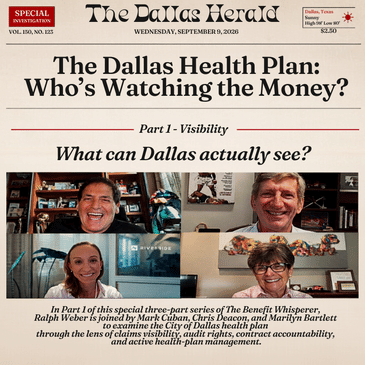
In Part 1 of this special three-part series of The Benefit Whisperer,
Ralph Weber is joined by Mark Cuban, Chris Deacon, and Marilyn Bartlett to examine the City of Dallas health plan through the lens of claims visibility, audit rights, contract accountability, and active health-plan management.
The conversation explores:
• What does a “99% claims accuracy rate” actually measure?
• Why claim-count accuracy and claim-dollar accuracy are very different
• What Mark Cuban found after obtaining and reviewing the Dallas health-plan contract
• Whether limiting an audit to a small number of claims gives a plan meaningful oversight
• Why employers need access to their underlying claims data
• How Marilyn Bartlett approached claims, banking, and large-case management in Montana
• Why Chris Deacon believes employers must look beyond headline administrative fees and examine the actual contract terms
• Why Mark argues healthcare needs to be managed like any other major business expense
One of the central questions in this episode is simple:
Before asking employees to pay more, shouldn’t the organization funding the health plan know exactly where the money is going?
This is Part 1 of 3.
Part 1: What Dallas Can’t See - and Why That Matters
Part 2: What’s Buried in the Contract and Incentives
Part 3: How Dallas - and Other Employers - Take Back Control
Subscribe for Parts 2 and 3: Subscribe to my YouTube Channel and watch the video podcast!
Guests:
Mark Cuban - Entrepreneur and Co-Founder of Mark Cuban Cost Plus Drug Company
Chris Deacon - Healthcare attorney and former Director of the New Jersey Division of Pensions & Benefits
Marilyn Bartlett, CPA - Nationally recognized healthcare cost-containment leader and former administrator of the Montana Employee Health Plan
Host:
Ralph Weber | The Benefit Whisperer | Route Three
[00:00:00] Healthcare isn't broken. It's working exactly as designed for the people who never send you the bill. Every year, employers fund more and more care and see less and less of where their money goes. Prior offs, denials, PBMs, markups stacked on markup. This is the show that says the quiet part out loud. I'm Ralph Weber, The Benefit Whisperer, and if you write the check, you deserve to see inside the black box.
[00:00:28] Okay, welcome back to The Benefit Whisperer. Today, we're talking about a really important topic. We've all heard the news in the city of Dallas. The city is getting a big increase. They are considering reducing benefits and there's a lot of information out there and a lot of misinformation, but I've got some incredible guests here, which I'll get into it in a minute. But I think at the end of the day,
[00:00:53] what it boils down to is just a couple of things. The PBM and the TPA is saying one thing and the client is saying another. So basically, let me put it this way. The TPA says, We have a 99% that you agree. Excellent. Stop asking questions. And then the client is saying, Yeah, but 99% of what? We just want to see the bills. Can't we see the bills? Classic.
[00:01:23] So that, you know, and those are the normal questions that we should be asking in healthcare. You know, as you all know, I used to be an air traffic controller and if we had 99% accuracy in air traffic control, I'll tell you what would happen. 1% of flights worldwide, like in the US, their 1% of flights is 450 flights a day with an average of 64 passengers. So at the end of the day, in air traffic control, we didn't say, Hey, we had another day with 99% accuracy,
[00:01:51] because that would be a crisis. Somehow in healthcare, it isn't, but it should be because it is 1% of 5.5 trillion is $55 billion. You know, so that 1% sounds like a small number, but when you look at the denominator, it's really not. And they're really well. Anyway, we'll get into this throughout the episode. I've got three incredible guests just very, very quickly. For those of you that don't know Chris, she, Chris and Marilyn are both powerhouses.
[00:02:21] They have done amazing things in the public sector. Chris in the state of New Jersey. And I'll let her say a little bit more when she gets on saving the New Jersey about $2 billion over three years. And Marilyn in the state of Montana, putting the whole state, the state health plan on direct contracting platform. So that was a huge number brought the state from almost insolvency on the
[00:02:48] health plan to a surplus of over $100 million. So anyway, and Mark, you need no introduction, but everybody appreciates so much what you're doing, using your voice to talk about what's right and what's wrong and what we need to do. So with that said, Mark, I'll start with you because you were the one that first brought this to my attention, the city of Dallas. So do you want to kind of just jump in and... Yeah. I mean, I did a records request for the city. Well, let me take a step back.
[00:03:18] Several years ago, I went down to the city of Dallas and met with them, talked about Cost Plus, and they literally included Cost Plus in the contract, but not in a way that anybody would use it. You know, it was just there as an option, but nobody told anybody about it. Right. And so, okay, just what it is. So their heart was in the right place, but they used a consultant who basically
[00:03:41] did them no favors. And I saw an article recently that the city of Dallas was $60 million over budget. And a big problem of that was their healthcare plan. And they were going to have to increase costs for members, et cetera. And so I did a records request because I wanted to see the contract and got it. And oh boy, it was a doozy. And I feel bad for the city of Dallas because it was 1300 plus pages,
[00:04:08] you know, and there's just no set of humans on the planet who can go through any 1300 page contract and get it right. I mean, it's just literally impossible. And so they obviously had to depend on others, this consultant and the things that you saw in there, like having to pay 15,000 to audit, you know, there's just a long, long list of things that they didn't have to accept, but they did. And so
[00:04:34] I went through and run it, ran it through Claude, ran it through ChatGPT, ran it through GrokBot, ran it through Gemini, basically starting with Claude, taking the output, put it in ChatGPT and say, what do you think? What comments do you have? And then making this circle until one by one, everybody, all the chatbots agreed on it. And I gave them my feedback on top of that. What about this? What about that? Right. And so I just kept on pushing them in different directions
[00:05:03] until we came up with a contract that, you know, one of those would, you know, well, one contract, what it should be. And then going through their contract and basically doing what I always do and say, where, where did they screw up? Where are they getting ripped off? And then publish that. And the list was long, but before I published it publicly, I sent it to them and said, Hey, let me help. Let me put, let me see if I can help you figure this out and get you on the right path because there's a renewal option in there and all that kind of stuff. Yep. Didn't hear a
[00:05:32] word back. Well, I take it back. I did hear initially. Yeah, we'll get right back to you. And that was the last I heard. Right. Wow. Sadly, I'm not, I'm not surprised, but the solutions are out there, you know, and the, I think the key is, you know, number one audit. And we're going to talk about that a lot. I was talking to Chris and Marilyn this morning, you know, as a government plan, as a public sector plan, it's not under ERISA. So they don't have to publish a 5500, a 990.
[00:06:00] There's much less disclosure or the, you know, the CAA disclosures. So there's a lot of disclosure that you would normally have in the private sector that you don't have. So they're just silent. Right. On things like that, that, that alone is a problem. The auditing rights we're going to talk about, I think there's probably on this size case, probably 500, that half a million claims a year.
[00:06:24] And with a 99% accuracy rate, I don't think the PBM has to pay a penalty, which is only 49,500. I don't even think they've seen the claims, right? That's even worse, right? Yeah. Because they, they have no ability to understand what their population needs or what they, what they faced or where the costs are coming from, or how to be proactive to deal with it. You know, how to get ahead of the curve. If you've seen trends, all those things, you know, before you even
[00:06:51] get to GOP-1s and specialty drugs. And so I think until you, it's not only about being transparent with the information you present or you have, but also being able to acquire the information you need in the form of claims, you know, and on the medical side, just being able to cross foot it between the 835s and 837s. So you have a clue about whether or not you're being charged correctly and whether the hospitals are charging you correctly. And if you can't get to the details, there's no ways to fix
[00:07:21] them. Yeah. I mean, Peter Drucker always says you can't control what you can't measure and you can't measure what you can't see. So not being able to see that, you know, we're spending hundreds of millions of dollars and they can't, they're told costs are high. They have no idea. Okay. They have no idea. Spending a lot on GLP-1s. Go ahead, Chris, jump in, please. No, I was also going to say on, you know, statistics like payment accuracy or timeliness of
[00:07:47] payment. You know, number one, what is the definition of accuracy in the contract? What is payment accuracy? And you would be shocked to know what it is and what it is not. And, you know, oftentimes, right, we know, you know, how much of the plan spend is these really high cost claims, right, that make up a very, very, very small percentage of your overall claim number. So it's,
[00:08:12] if it's an accuracy over a claim count versus a claim dollar, right, which is the unit we should be using, I don't really care if it's 99% accurate. If the 1% of the claims are actually the 1% that matter to me for my spend and for stop loss. Right. Right. No, exactly. Great, great. Well put. Yeah. If you don't know the claim, you can't determine if it's going to be applicable to stop
[00:08:37] loss and the stop loss vendor is going to tell you it's not if it's not perfect. Yeah. You know, you just set yourself up for failure and expense in ways and they don't even know. I mean, and to protect, you know, to kind of, you know, protect the city of Dallas, they don't have enough people in HR to deal with all this, right? They're trying to deal with the problems of dealing with the healthcare system, denials, et cetera. And it probably shouldn't be in HR in the first place.
[00:09:04] It should be somebody dedicated to healthcare, a healthcare CFO, a healthcare contractual analysis, analyst, you know, all these things that nobody, nothing's changing in how we approach dealing with the cost of healthcare. And that's the fundamental problem. Yeah. Exactly. Marilyn, I saw you nodding there. So just background. So, so Marilyn, you're a CPA, so you're an auditor. That's what you do. That's
[00:09:30] your bag. Tell us just like, you know, 20 seconds, what you did in Montana, which is much bigger scale than the city of Dallas and then jump in from there. Yes. In Montana, I, the TPA carrier we had would not give me all my claims fields or would not give me my claims. So we did an RFP, we got a new TPA and we did direct contracting with our TPA for all 60 hospitals in Montana to pay based on a multiple
[00:09:58] of Medicare. And we put in a transparent pass-through pharmacy that was 10 years ago. A lot has changed since then, which Mark can speak to. And the other thing which kind of ties into the conversation we're having right now is we had our own data warehouse and our own bank account. So the claims could be written on the bank account, but we reconciled it and we could see what the payer was actually paid.
[00:10:21] But we monitored those claims. And when a large claim came along, we negotiated case rates. So it does no good at the end of the year. Yeah. To come back and say, well, you have these large claims. Well, you knew they were coming. We had one horrible case on end-stage renal disease. We negotiated a case rate. We did, and we made faster payment. So there's a lot you can do, but you got to actively
[00:10:47] manage it. And I'm sorry, but I didn't rely on my consultants and brokers to do that. The health planning to do that. Yeah. And I think the key is to have all this moving in real time, you know, and here I'm going to jump back to my ATC roots. In the last 10 years, there have been exactly 72 lives lost due to ATC error. 72 lives out of tens of millions of passenger flights. And that's because in
[00:11:16] real time it's happening and it's auditing. And like I said, we can't say 1% error rate today. Good job. 137,000 people might not agree, but the rest of you do. So you're right, Marilyn, seeing it in real time, watching it and getting in front of it. So Mark, now if you had the ability, if, okay,
[00:11:41] speak as a business person, if somebody says my costs are going up, I don't know what. Now the right to audit, and Chris, I'll get you to sound in on this. What I saw is that on the PBM, on the pharmacy side, they can actually audit all of them, but on the health side, which is the bigger side, only 300 claims per year. Now I'm not sure if that includes the pharmacy one. Mark, are you aware of any claims
[00:12:05] that have ever been audited? Because I couldn't find anything on the public record about any audits that have ever happened. From the city of Dallas or any of the... Yeah, yeah. No, no, no idea whatsoever. I would doubt it. But I always, when I go to different groups and talk to HR and CFOs, I always ask who's had an audit of their claims. Yeah. And then I've asked who's been overpaid for rebates and who's been underpaid. Nobody's ever been overpaid, right, with a rebate. Everybody's
[00:12:31] been underpaid. Yeah. Which is why, and I've even offered to pay for audits for corporate clients because I'm like, look, if you don't get more money back than you, you know, then, you know, I'll pay for it. And, you know, no, it's, I've never had to pay for it. Yeah. But to your, to your point, right, the bigger issue is doing an audit requires work, right? So now they know there, it's kind of like an enforcement arbitrage by the PBM or the ASO where they know that the chances are
[00:13:00] that the client, whether it's a company, a city, a state is actually going to do any type of audit of any of the terms in the contract is very slim. And they just make the bet that they won't do it. Or, you know, if it's a state and now they're starting to audit a whole lot more like Arkansas built it in, then you even saw that there was report from the state of Arkansas that they have to issue report every year for their PBMs. And it said one of the PBMs literally was listed as impeding
[00:13:29] the progress of the investigation. They wouldn't participate even though it was a relatively new contract. And so now, you know, to go back to the core of your, your question, Ralph, whether you're a city, state employer, whatever, commercial employer, whatever it may be, you have to start thinking about this like a real business. You have to ask if you were reinventing this, if you were recreating this, what process would you take to get the best set of circumstances for your,
[00:13:55] your company? And I think what Marilyn did in Montana is exactly that. She didn't say, this is the way it's been done. Let me try to improve it on the edges. She said, what's a better way? And the template of a pass-through ASO that you pay on a specific basis that has nothing to do with the cost of care, the cost of medications, right? That's the first step, you know, pay them for the services that they offer them, the ASO and the PBM, and then your control of everything else,
[00:14:21] right? Whatever you can negotiate, direct contracts and like on costpluswellness.com, that's the whole foundation. For my companies, when we self-insure, I want to negotiate direct contracts with everybody. And I'm willing to say, I'm going to pay you what the, I'm going to pay you the contracted rate. I'm going to pay you same day or 30 days, whichever you prefer, right? But in exchange, I want a great price because you don't have any of the risks of being a provider that you do
[00:14:49] with every insurance company. And Marilyn, you know better than I, most insurance companies don't, I mean, most providers don't even know if any given plan for any given insurance company is profitable or not, right? They just assume that they need the volume, otherwise the beds will be empty. And you have to stop thinking that way. You have to say, what's the best way for me to approach it? And the hard part is having somebody in your organization who's capable and willing to
[00:15:15] do that. And because, you know, the hardest part for all these pass-through PBMs and pass-through ASOs is convincing HR that they can deal with change because HR is terrified that, you know, they've got a denial somewhere and that takes up 80% of their time. And they don't want to hear all their members coming back and saying, well, where's the logo from this big buka on my card, right? That's what I want. So we have to start educating HR, start educating CEOs, actually. It's time to
[00:15:44] bring in a healthcare CFO. And to Marilyn's example on the single case, if you can schedule it, you can negotiate it and you should be able to negotiate everything. Yeah. No, exactly. Wow. Great case. Chris, go ahead. I was just going to say, unfortunately, you know, if you are with a buka, that ability to negotiate a case rate is often thwarted. I tried to do that on behalf of a client that had Cigna. They knew they
[00:16:10] were having an upcoming, very costly procedure, contact at the hospital, spoke with, you know, and even used contacts to get to the right office. They would not speak to me unless I was willing to put in writing that the individual did not have coverage with any of, you know, listed carriers. Were they self-insured? Yes. Which is the crazy part, isn't it? Crazy.
[00:16:33] It's their money. You hired this ASO to manage, you know, your members and handle the administration of it. And obviously they're cheating because they won't, you know, they should be glad that the price is lower because that's the goal, right? Right. Well, you would think so. And the hospital, you know, the carrot, to your point, Mark, is we were willing to pay a very fair rate up front. We would have prepaid, right? And now sitting here today, you know, well over a hundred
[00:17:01] days later, the hospital hasn't been paid on that claim. Wow. A hundred days. Of course. You know. And when they're paid, they're not going to be paid the contracted rate, right? They're going to be paid less. Right. And, you know, who knows what happened with the deductible for the member, right? The member may or may not have been able to afford the deductible and probably the provider had to loan them the money to be able to deal with it so they can get to the insurance company. Yeah. I mean, it's so stupid.
[00:17:31] Yeah, it is. Now, you know, Mark, if one of your companies, if one of the CFOs from your company, CEOs came to you and said, hey, we've got a $40 million cost overrun and we really don't know where it is. Can we just get an increase? I mean, would you tolerate that? No, of course. It's crazy. No, of course not. Literally one of my portfolio companies I'm working with right now, they got a proposal from a company called Sequoia, right? And I don't know if you've ever heard, I had never heard of them in
[00:17:59] the benefits space. And in any event, it was a Blue Cross Blue Shield option and an Aetna option. I don't think there was a Cigna option, but they were all 19.2, all of them were 19.21% increases. I'm like, how in the world do two different BUCAs come back with the exact same number, right? And then you look at the 5,500 and those numbers from the broker were crazy, right? Like
[00:18:26] incredible. So fortunately they're in the state of California and I went to Claude and I'm like, here's what we got going on. What do you suggest? And Claude was like, you do a DHCM and I don't even know what DHCM stands for, but you can go to the Department of Healthcare, done something with the M and it even wrote out the letter to send to the department. And you can ask for a judgment on the
[00:18:51] increase that was offered to you and they have to come back within five days. And so that's what we're doing right now. And Claude estimated they might be able to negotiate it down to 6% increase, which isn't optimal, but it beats the hell out of what they were doing. And the broker and the two companies, the two carriers were pushing, they were trying to put a time limit on, you got to do it within 11 days. And I'm like, they're only doing this because they're ripping you off. And fortunately
[00:19:21] I reached out to them and said, look, you guys are growing fast. Let's look at your healthcare options to make sure that you're not getting ripped off. And it turns out they are. Yeah. California is weird, Mark, because they have Steve Poizner used to be the, he's a friend of mine, used to be the insurance commissioner back in the Arnold Schwarzenegger days. And they have in California, the Department of Insurance and the Department of Managed Care. So, and the two are separate. And also Blue Cross, Blue Shield is two
[00:19:49] companies in Canada, in California. Blue Cross is regulated by the Department of Insurance, Blue Shield and Kaiser and, you know, companies like that, Department of Managed Care. So it just adds one more level of confusion. It's crazy. I'm looking real quick here to see if I can find that letter because it's crazy, right? I didn't know it existed. You know, all these laws and everything that have been passed over the last few years. So I'll let you guys know in a second. Yeah. So Chris or Marilyn,
[00:20:17] either one of you, for a quarter of a billion dollar plan that has maybe 500,000 claims a year, is auditing 300 of them reasonable to find errors? I'll take this one, Marilyn. So I think the obvious answer is no, but I think one of the really intriguing parts about this specific
[00:20:41] contract in Dallas is that the standard contract that all vendors have to sign, the 12-page contract, requires that 100% of the claims be auditable. And not just the claims, but provider contracts. It's a very, very wide audit provision. But what they've done is in the actual negotiated contract with Blue
[00:21:06] Cross Blue Shield is if they've included an exhibit that says, it actually says that the city can audit 100% of claims and select 300 claims a year to do so. You do the, I don't know how that works, right? Yeah. But beyond that, right, there's no extrapolation. Meaning if you found a 20% error rate,
[00:21:31] you might get some money back. The other thing is if you did find overpayments, if you did find systemic overpayments. Yeah, hit them with it. Hit them with it, Chris. There is a contract provision here that says they don't have to give it back to you unless it was grossly negligent, right? Yeah. Or, you know, sort of borderline fraud. So even if you found a ton of money in an audit of 300 claims,
[00:21:59] which you don't actually get to pick the ones you want to audit, right? There's still no recourse. There's still no recourse. And, you know, yeah. I'm sorry. Go ahead. Go ahead. No, you go. I was going to say, and most likely in that contract, the ASO says that if you, even if it's fraud, right, and that you determined that they overpaid by 25%, they want their 25% of the amount of the savings. Of the recovery. Yeah. Yeah. Absolutely. Crazy.
[00:22:28] Absolutely. And I think you go back to your point earlier about, you know, catch me if you can type of mentality. You know, my story in New Jersey is, is this, we had a contract provision that said that the carrier Horizon Blue Cross Blue Shield could only charge the lesser or lesser of the negotiated amount or the billed amount. You know, we've been sold this idea that sticker price is a funny number and you're always going to pay less. You're
[00:22:57] always going to pay some discount off of the sticker price and the billed amount. When in fact, that isn't the case. And in some cases I found we were overpaying on 50 claims alone. It was over $12 million in overpayments. Right. And when this, so this was the subject of the whistle, one of the subject matters of the whistleblower complaint that eventually resulted in them paying the state a hundred million dollars. But what the, what the deposition testimony found and was recited
[00:23:24] in the settlement agreement was that they knew they weren't going to comply with that provision. And they took a calculated risk saying, well, if we get caught taking the cookie out of the cookie jar, we can just put it back. No harm, no foul. And that's the position we'll take. So yeah. Cost of doing business. They know they're not going to get caught. I testified to the state of Texas the other day. Right. And that's what you said is exactly one of the six, five things that I told them. And I said, look, this is just a cost of doing business.
[00:23:52] Right. It's just like, if we get caught, we get caught. The numbers aren't that bad. And what I told them that they need to start doing is you get one mulligan. If in the state of Texas or from a federal agency, you get fined for cheating, lying and stealing in one way or the other. Okay. You get, but if you get hit a second time, you can no longer do business with the state of Texas or any, any of the city, states, school districts or anything in the state of Texas.
[00:24:16] So who knows if they'll do it, but that's the way to fix that problem of it just being a matter of probability and cost, an arbitrage. Right. But, but, but Chris, they don't even put the whole cookie back. They just put three chocolate chips back. Well, they put three chocolate chips and I'll take it back to sort of the, the subject of what we're talking is this Dallas contract. And, you know, you
[00:24:39] very much think, well, it's a PM PM. It's an, it's an ASO, but I actually went through and pulled out all of the additional fees, right? And it's two pages of this two pages. And most of them are percentage fee based around 25 to 30%. And I went through and did sort of a conservative estimate based on claim spend of 200 million and an aggressive estimate, a conservative estimate of
[00:25:05] additional costs in addition to their PM PM SO fee. They're looking at about $7.5 million to $12.5 million. And I, and I am being fairly conservative here and additional fees that are going to be generated for the vendor solely as a result of, you know, all of these tack on fees. And, you know, that's not when they're doing an evaluation. I am sure that they're looking at the fee, right? $35
[00:25:32] a month. And they're saying, well, that's better than so-and-so is $30 a month. Those numbers mean nothing, right? You have to look under the hood on all of these, all of these, you know, percentage based and fee based things. I'm really glad you brought that up and thank you for sharing that document. One of the things that we're finding claims, first of all, when they say you can audit the claims, you know, do you get all the fields? And pretty much not. And what we're finding in these
[00:26:01] savings programs, overpayment recovery, the things that Chris is talking about is that they will pull out their fee first and they're maybe 30% of the overpayment, even if it was their fault. We find where a claim is denied and they take their 30% and then the next week they pay the claim. So you've got to really get all those fields. And I didn't see a lot of that disclosed in this contract. It's just sort
[00:26:28] of buried in there. Oh, no. Yeah, not at all. And no, exactly. And I can just picture Mark, you know, one of your employees, you caught them stealing $100. Well, here's $70 back. I'll go back to work now. Yeah, right. Yeah. I mean, it is just crazy. Yeah. But it really points to the fact that you can't start from the PBM or ASO contract. No. Those days have to be gone. That's
[00:26:54] the default up till now where it's like, okay, you know, we picked you from the RFP or the broker picked you, whatever it may be, or the consultant. Send us your contract and we'll work from there. If you work from a contract they send you, you've already lost. I call it contractual terrorism. You know how they talk about terrors? You know, they only have to be right one time and we have to stop them every time. The contractual terrorism from the PBMs and the ASOs, they can sneak things
[00:27:20] through like Chris and Marilyn are talking about. And unless you know specifically to look for it, there's still going to be 50 other things. And all they have to do is sneak through one, two or three of them. And it's going to cost you millions of dollars, if not more. And so that's why I published that open source contract so that everybody has got one to start from. Now the PBM is not going to agree to 99% of it upfront, but there are pass-through PBMs that will agree to it because it's how they do business. Right. Right.